Roof Insurance Claim in Tahlequah, OK
A hard blow can break a shingle's seal long before the roof ever leaks. Your policy may name roughly a year to file, yet Oklahoma law can carry a wind or hail claim out to 24 months.
- Your roofer finding the source, not just the symptom
- No pushing, decide on your own time
- Repair when repair is enough
Call (539) 234-6218
A roof insurance claim in Tahlequah turns on damage you cannot see.
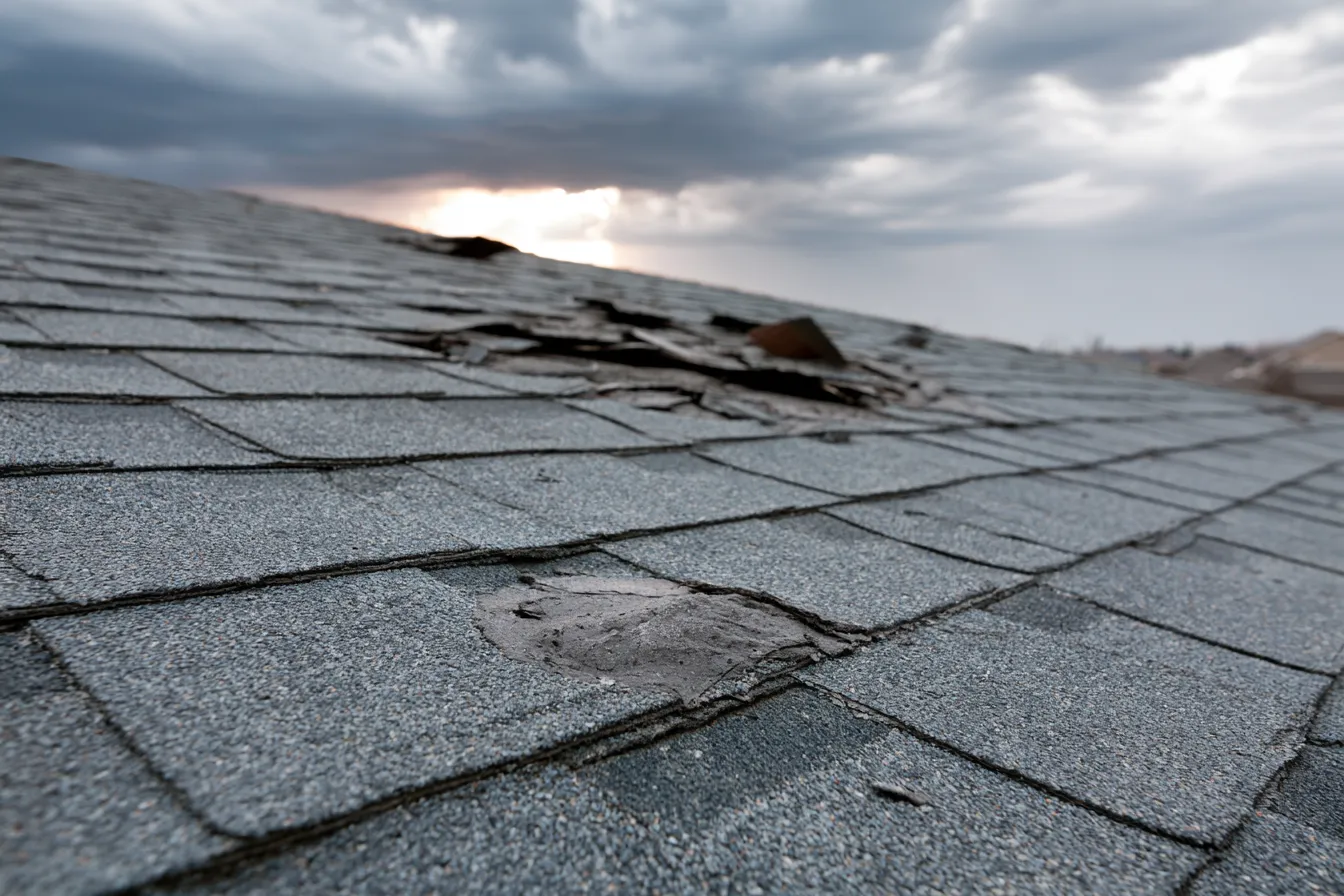
A roof insurance claim in Tahlequah, OK often begins with harm no one could spot from the driveway. Plenty of owners treat the policy's one-year window as a firm cutoff and let it slip by.
Under Oklahoma's House Bill 3495, a wind or hail roof claim can be filed for as long as 24 months from the date of loss when the damage was not evident without an inspection, which makes a dated inspection the thing that proves which window applies to you. With that settled, the storm-damage walk-through sorts genuine Cherokee County storm damage from plain wear.
Walk a Tahlequah storm claim from first ladder to final check
Each stage below introduces one term you will actually need, in the sequence it comes up, with the two-window question worked in where it counts and every decision left in your hands.
The ladder comes before the call
The whole claim hinges on a single date, the day the storm struck, and after a Tahlequah storm you can usually name a real one. So the opening move is a ladder rather than a call to the insurer. Working slope by slope, a local roofer marks where a hard blow peeled up a shingle or a slope took a direct hit, then ties it to a storm the Cherokee County record already holds. No filing happens at this stage. The visit decides whether a claim is even worth opening, and it locks in the date from which both windows are counted.
date of lossOne year, or up to twenty-four
Here the Oklahoma rule departs from a flat one-year deadline. A policy will usually state a contractual window of about a year, but under state law a wind or hail roof claim can run up to 24 months from the date of loss whenever the damage was not evident without an inspection. What a dated inspection does is demonstrate the damage was latent, and that is what brings the longer window within reach. The precise dates are set by your own policy and the Oklahoma Insurance Department, never by the roofer.
latent damageThe call is yours to make
File in hand, you call your own carrier and open the claim in your name, comfortably inside whichever window applies. The insurer assigns a claim number; each later step points back to that number. A roofer deliberately stays off this call, because opening the claim and directing it are yours alone to hold.
claim numberTwo reads of the same slopes
A few days or weeks later the carrier sends its adjuster to assess the roof and decide what the policy will cover. Scheduling that visit for the same hour a roofer is up top helps. With the dated file already assembled and both parties standing on the very same slopes, the ruling rests on recorded damage instead of a glance from the yard.
adjusterWhere the roof meets the paperwork
Back comes the insurer's scope, a line-by-line account of what it agrees to pay. Set beside the dated file, the omissions stand out, and whatever the storm caused that the scope skipped goes back as a documented request as soon as it turns up, whether decking found soft once the tear-off is underway or a code item the old roof never had, when the policy includes ordinance-or-law coverage. Each one is weighed by the carrier.
scope of lossThe second check, after the last nail
Under a replacement cost policy the carrier withholds a portion, the recoverable depreciation, until the new roof is finished and invoiced. Submit that paperwork and the withheld amount arrives as a second check. Abandon the job or never invoice it, and that money simply disappears.
recoverable depreciationACV or RCV, and which your Tahlequah policy settles on
A storm claim generally arrives as two checks, the first being the lighter one. The value your policy names decides how much of a full roof replacement the carrier will actually fund, which is worth understanding ahead of the next storm rather than in the middle of it. Each card sets out one term in plain money.
The old roof, minus the years it has served
Under an actual cash value policy, ACV, the payout reflects the roof's depreciated worth at the moment of loss, docking value for each year the shingles had already been up there. That single check is the lighter one, and because nothing is set aside as recoverable depreciation, there is rarely a second payment to chase down later.
A new roof, settled in two checks
RCV, replacement cost value, pays for the whole new roof, just not in one check. The first payment covers the depreciated value; the recoverable depreciation stays with the carrier until the finished job is invoiced, and then it follows.
Your deductible is your part of the claim, and Oklahoma law protects that share. A roofing contractor is forbidden to pay, waive, rebate, or absorb any piece of it, so anyone offering to eat your deductible is offering to break the law to land the job. What serves you instead is the true figure stated up front, a written estimate built around it, and no make-believe credit the statute would never permit.
Your policy's year set against Oklahoma's 24-month reach
One Tahlequah roof claim, seen two ways: the contractual window a policy names, and the longer stretch Oklahoma law can open. Which one you are actually on is decided by a dated inspection.
| On a Tahlequah roof claim | The policy window | The Oklahoma window |
|---|---|---|
| How long you have to file | About a year from the date of loss, as the policy names it | Up to 24 months from the date of loss, under Oklahoma law |
| When it applies | The standard window written into most policies | Wind or hail roof damage that was not evident without an inspection |
| What proves your window | Little more than your memory of the storm | A dated inspection tied to a Cherokee County storm on record |
| Who sets the exact date | Your policy language | Your policy plus Oklahoma law and the Oklahoma Insurance Department |
Neither window alters what your policy owes; they alter how long you have to act and what proof it takes. The dated inspection is the piece establishing that the damage was not evident from the ground, and that is what brings the longer Oklahoma window into play. Check your own dates against your policy and the Oklahoma Insurance Department before relying on either.
Tahlequah storm-claim questions, from the filing window to the final check
The questions Tahlequah owners raise about timing, the two windows, the deductible, and getting a roof claim paid.
Q1How long do I really have to file a roof claim in Oklahoma?
Q2The storm was months ago and my roof looked fine. Am I too late?
Q3Can a Tahlequah roofer pay or waive my deductible?
Q4Will an impact- or wind-rated shingle lower my premium in Oklahoma?
Q5My policy names ACV. Does that settle my Tahlequah roof differently than RCV would?
Q6My older downtown home took storm damage. Does its age still leave a claim?
Put a dated inspection on the claim before time runs out
Reach out to Tahlequah Peak Roofing and a local roofer records the storm damage slope by slope, ties it to the Cherokee County record, and files a dated inspection.
That file is what shows whether the longer Oklahoma window belongs to you, and the claim stays in your name from start to finish. The look is free, and if the roof carries no real claim, that is precisely what you will be told.